
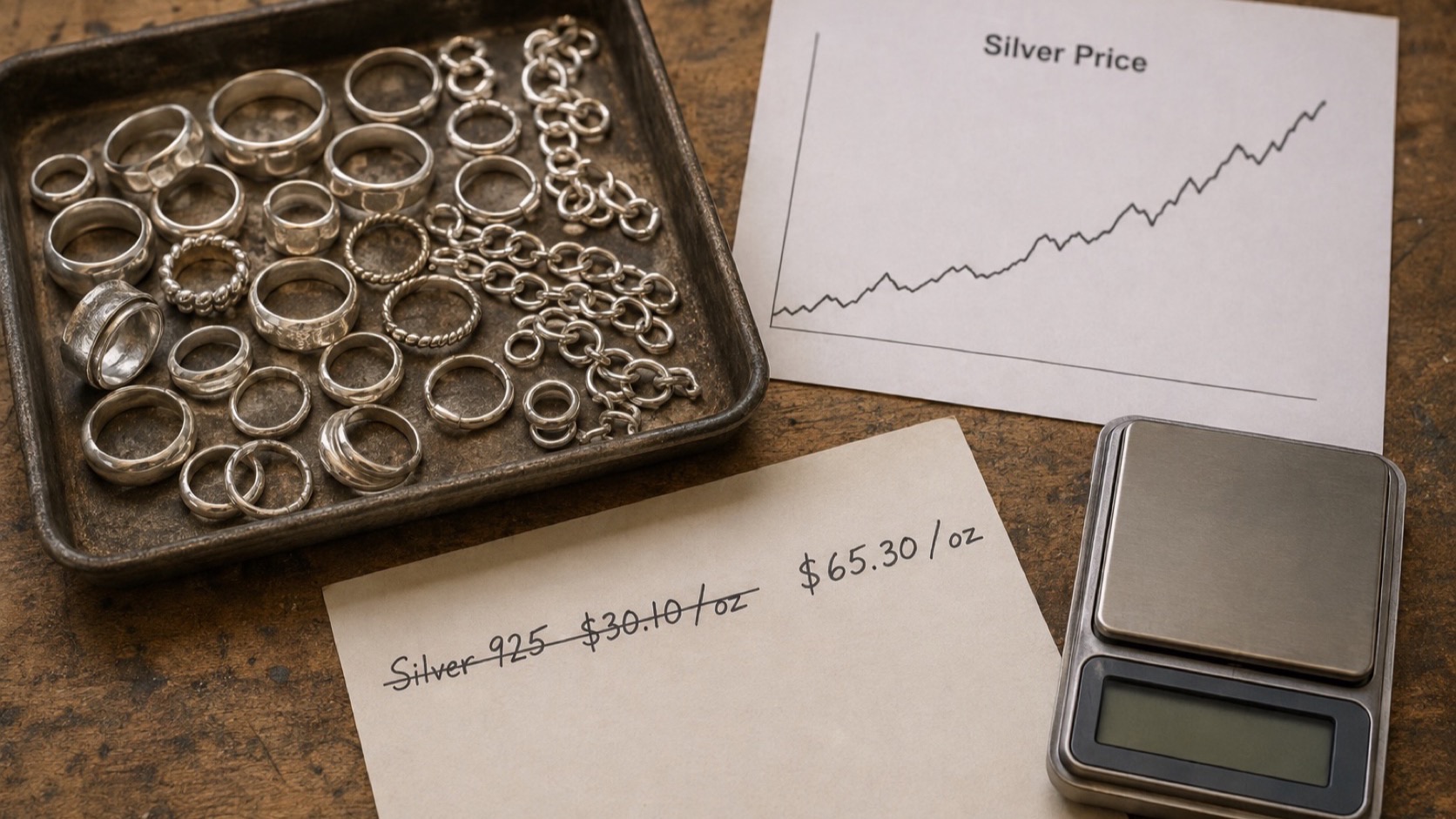
The biggest jewelry company in the world just showed everyone its cost problem. In its August 12 report, Pandora disclosed that the silver in its 2026 cost of goods is hedged near $32 an ounce, and that 2027 is 90% to 100% hedged near $65. Commodities took 170 basis points off its Q2 margin, tariffs another 150, and inventory rose to 17.8% of revenue from 14.6%. Its answer for 2027 is to move about half its silver assortment to platinum-plated silver.
Spot silver was $65.33 on September 2, up 59% in a year, even after falling from January's record above $121. Gold is $4,388, up 23%. A brand that hedged nothing is paying today's prices on every casting, and a brand whose cost sheet was built in 2024 is reporting margins that are not real.
The direct answer: three decisions belong to you before Q4 buying is done, and they are accounting and tax decisions as much as merchandising ones. What metal price sits in your standard cost, and when replacement cost hits the P&L. Whether to elect LIFO for 2026 while metal is high. And what your lab-grown inventory is actually worth.
The margin you are looking at is old metal
Most jewelry brands cost inventory at average cost or first-in, first-out. Both methods carry last year's silver into this year's cost of goods sold, so the P&L keeps showing the margin you had when silver was $30. The replacement cost, what it takes to re-make the piece today, is double that. The gap does not appear until the old layers are sold through, and by then the pricing and buying decisions that depended on the real margin have already been made.
The fix is a standard cost by SKU that uses current metal, stone, labor, and the post-July 24 duty rate, refreshed on a schedule. Report the margin on that basis alongside the book margin. The book number is right for the financial statements; the standard-cost number is the one to make decisions on.
Pricing is the tempting response and often the wrong one. The World Gold Council reported US gold jewelry demand down 25% by weight in Q2, with buyers moving to lighter, lower-karat pieces. The large brands are answering with mix and weight, not list price: 10-karat, vermeil, platinum-plated silver, lighter designs at the same price point. That is a cost-sheet decision, which is why the cost sheet has to be current first.
The LIFO decision, this year
When costs rise, last-in, first-out matches today's high cost against today's sales and pushes taxable income out. A jewelry brand with rising metal cost and steady inventory can defer a meaningful amount of tax with an election on Form 970 filed with the return for the year it starts. Many brands use the index method, which prices inventory pools with published price indexes instead of tracking individual layers.
Three conditions before you say yes. LIFO must also be used in the financial statements you show lenders and investors, so book income falls with it. It reverses when prices fall or inventory shrinks, which for metals can happen fast. And a LIFO taxpayer cannot write inventory down to market for tax, which matters for the next section. The election is made for the year with the return, so 2026 is decided by the time the 2026 return is filed, and the analysis belongs in the fall.
What your lab-grown stock is worth
Natural prices turned up in August for the first time in 15 months, with one-carat stones up 0.5% and half-carats up 2.5%. Lab-grown wholesale went the other way, down 13% in a year and down 96% since 2018, while growers pushed rough prices up. Retailers are reported to be carrying lab-grown at roughly half their inventory-to-sales ratio with markups above 80%, which is the margin that keeps repricing every time a competitor refreshes.
If you own lab-grown stones bought in 2025, some of them are on the books above what they would sell for. Books require a write-down to net realizable value; the tax rules allow a write-down to market under FIFO or average cost, with substantiation, but not under LIFO. Stones held on memo are not yours and do not belong on the balance sheet at all. Natural melee for Q4 designs is a buy-now question, because the deflation that made waiting free has ended.
Five things to settle before the Q4 buy
- Refresh standard cost per SKU at current metal, stone, labor, and duty, and report margin on that basis.
- Decide the LIFO election for 2026 with your preparer, with the lender's financial covenants on the table.
- Test lab-grown inventory against current wholesale, write down what needs it, and document the markdowns.
- Separate memo stones from owned stones in the books.
- If you are entering forward contracts on silver or gold, set the hedge policy and the documentation before the first contract, so the accounting follows the intent.
Where your facts change the answer
Made-to-order brands carry less metal and less risk than stocked brands; Brilliant Earth holds about 12% of sales in inventory against Pandora's 18%. A brand that casts domestically has a different duty picture from one that buys finished from Thailand. State income tax rules on LIFO and inventory write-downs vary. And a LIFO election is close to irreversible without IRS consent, so it is a decision to model, not to try. Our guide to the 74 ways inventory value and COGS go wrong covers the mechanics underneath all of this.
If your margin reports still assume last year's silver, and nobody has run the LIFO math for 2026, that is the tax planning work to finish before the Q4 castings are ordered.
Reading about taxes usually means paying too much of them.
Over 90% of the time our tax advisors find savings a previous CPA missed — for brands with $150K+ in net profit, a typical first-year plan uncovers $20K–$50K. Grab the free Tax Savings Checklist, browse the tax strategy playbook, or start with a zero-cost planning session.