
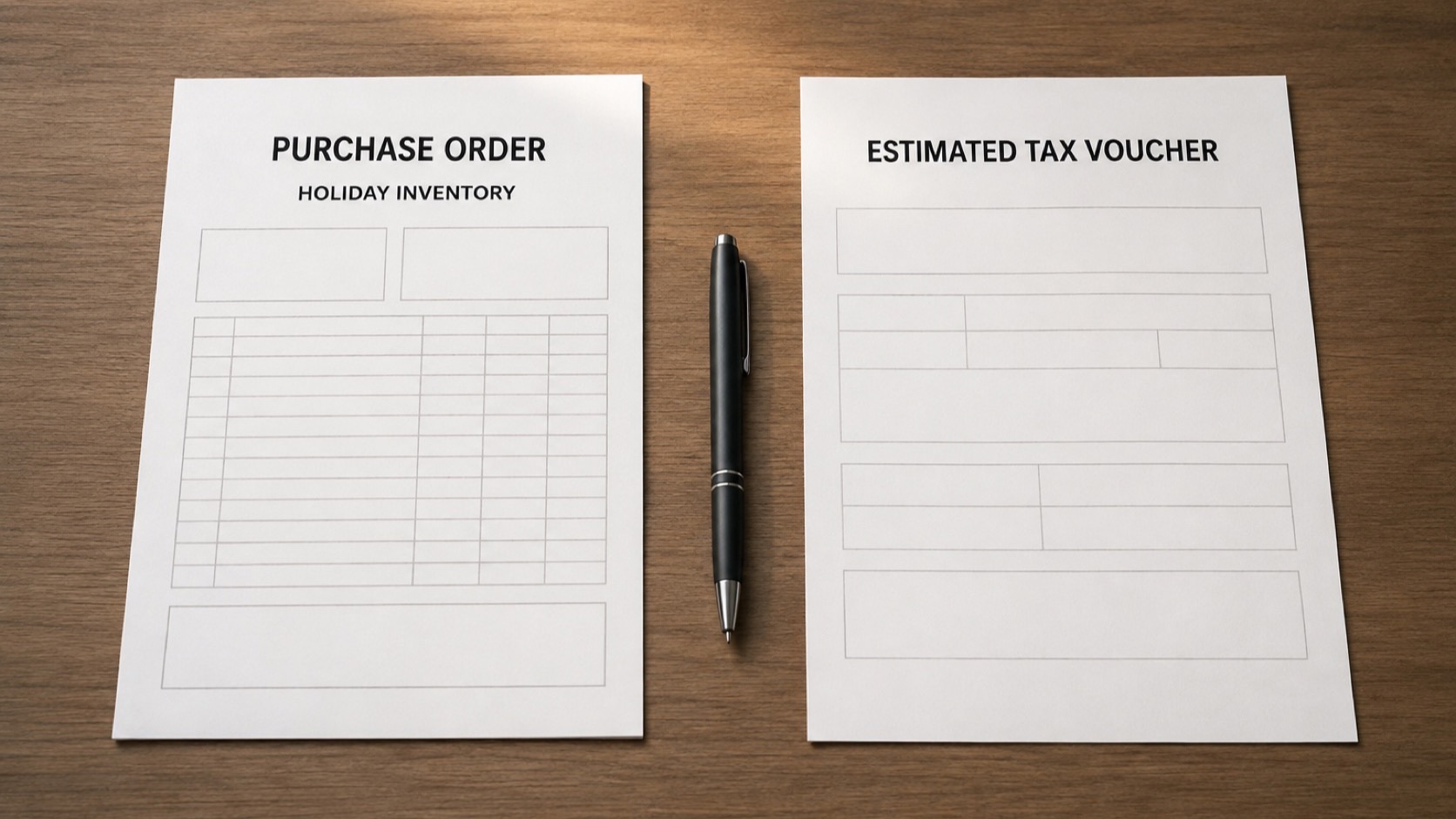
Your third estimated tax payment is due September 15. Your Q4 purchase orders want deposits the same week. If there is not enough cash for both, you are about to make a financing decision whether you call it one or not.
On August 21 the IRS announced that its interest rates stay at 7% for the quarter starting October 1, so the rate is fixed through the end of the year. That number matters because being short on an estimate is not a fine. It is a loan from the IRS at 7%, charged on the shortfall from the due date until you pay, and you cannot deduct it.
So price it like a loan. And before you decide anything, ask your CPA one question: what is my September payment under the annualized method? If most of your profit lands in Q4, the legal answer is often lower than the number on the voucher.
The price of being $40,000 short
As an illustration only: your September installment is $60,000. You pay $20,000 on time and the other $40,000 in January with the fourth payment. Four months at 7% on $40,000 is about $935. Because you cannot deduct it, an owner in the 37% bracket has to earn roughly $1,480 before tax to cover it.
Now the other route. An inventory line at 12% costs about $1,600 of interest on the same $40,000 for the same four months. That interest is generally deductible, with one limit covered later this week, so the after-tax cost is closer to $1,000.
Those two numbers are close. That is the finding. The IRS is not a free lender, and your credit line is not automatically the expensive choice. Which one wins depends on your bracket, your lender's rate, and whether you would draw the line anyway. What never wins is skipping the payment without running the numbers, because the IRS charge cannot be negotiated later and your lender's covenants do not care why the cash left.
You may owe less in September than you think
The IRS lets you avoid the penalty two ways: pay in at least 90% of this year's tax, or 100% of last year's tax, whichever is smaller. If your income was high last year, a higher percentage of last year's tax applies instead; Publication 505 sets the threshold and most owners at this level will hit it. If 2025 was a smaller year than 2026 will be, the last-year route may already make September manageable.
The bigger lever is the annualized method. The standard schedule assumes you earn profit evenly through the year, so it asks a Q4-heavy brand to prepay tax on money it has not made yet. The annualized method on Form 2210 computes September's payment from what you actually earned through August 31. A brand that earns 40% of its profit in the fourth quarter pays less now and more in January, with no penalty, as long as the books are current through August and the schedule goes in with the return.
If you pay yourself W-2 wages through an S corporation, there is a second option: federal withholding counts as paid evenly across the year, so raising withholding on year-end payroll can cure an earlier shortfall. Whether that fits your pay plan is a question for your preparer.
Three numbers to ask for this week
- My September payment under last year's safe harbor.
- My September payment at 90% of this year's projected tax.
- My September payment under the annualized method, from the books through August 31.
Pay the lowest legal one, on time. If there is still a gap between that and the inventory deposit, price it against your line using the rates in the August post on repricing Q4 inventory financing. Then put the January 15 payment in the cash forecast now, so a deliberate choice in September does not become a surprise in January.
Where your facts change the answer
State estimates have their own rates and rules, and if you elected a state pass-through entity tax, its payments change the federal picture too. C corporations follow different forms, and a large corporate shortfall accrues at 9%, not 7%.
If nobody has run your September number three ways, that is the tax planning conversation to have before the 15th, with the Q4 purchase schedule on the same page.
Reading about taxes usually means paying too much of them.
Over 90% of the time our tax advisors find savings a previous CPA missed — for brands with $150K+ in net profit, a typical first-year plan uncovers $20K–$50K. Grab the free Tax Savings Checklist, browse the tax strategy playbook, or start with a zero-cost planning session.