
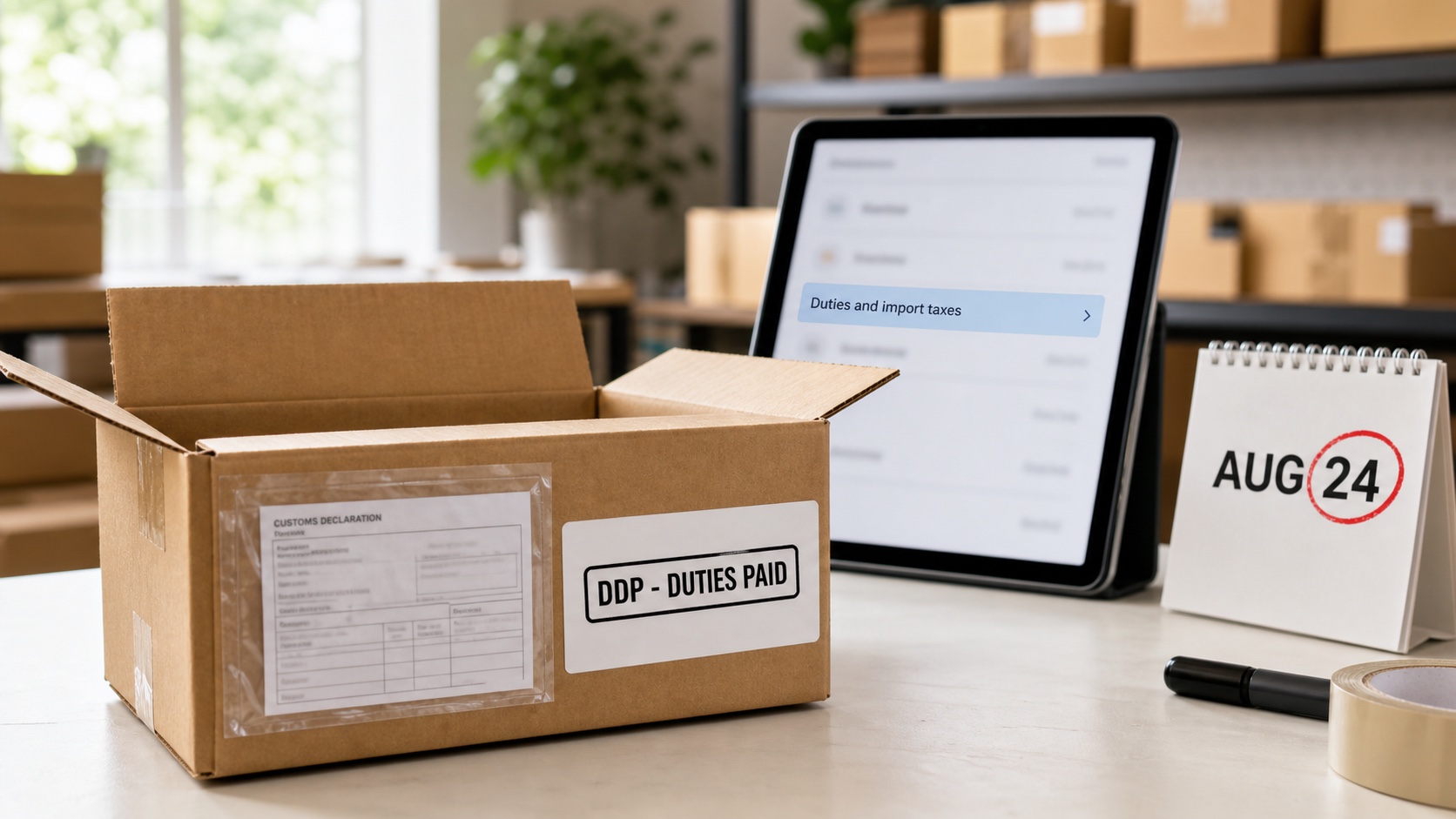
If any of your Shopify international markets still let the customer pay duties when the parcel arrives, that arrangement ends on Monday, August 24. Shopify's August 11 changelog post says Managed Markets will stop supporting delivered duty unpaid (DDU) on August 24, 2026, in every country where it already supports delivered duty paid (DDP). Markets on DDU move to DDP automatically. Customers in those markets will pay duties and import taxes at checkout instead of to the carrier or customs on delivery.
Shopify's stated alternative is blunt: if you want customers to keep paying on delivery, turn off Managed Markets before August 24. Otherwise nothing is required. That is the decision, and it is not a technical setting; it changes price presentation, conversion in those markets, who is legally selling the goods, and how the money reaches your books.
What actually changes at checkout
Under Managed Markets, Global-e is the merchant of record for the international order. Global-e handles duty and tax remittance, commercial invoices, and carrier arrangements, which is why you did not need your own tax registrations in those countries. With DDP, the duty and import tax are calculated at checkout from each product's HS code and country of origin, the customer pays them as part of the order, and Global-e remits them.
Until now some markets could run DDU, where the customer saw a lower total online and paid duties to the carrier on arrival. After August 24, the customer sees the full landed price before paying. For products with meaningful duty rates into a given country, the visible total goes up and checkout conversion may move. Delivery refusals, returned parcels, and "surprise fee" support tickets should move the other way.
What changes in the payout
This is the part to check with your accounting team. Shopify's payout documentation describes the math as total order cost, less remitted tax and VAT, less remitted duty, less the Shopify Payments processing fee, less the Managed Markets fee, less the currency conversion fee. The duty and tax the customer paid never belong to you. They pass through to Global-e for remittance and must not land in revenue.
The fees are yours. Shopify's help center currently lists the Managed Markets transaction fee at 3.25 percent on Plus and 3.5 percent on other plans, plus a currency conversion fee of roughly 1.5 percent, plus the Shopify Payments processing fee. Those percentages can change and depend on plan and settings, so confirm them in your own admin.
For the ledger, each Managed Markets order needs the same split you already apply to marketplace deposits: gross product sales, shipping charged, duties and taxes collected and remitted on your behalf, and each fee line. If your bookkeeper posts the net deposit as sales, DDP widens the gap because more dollars now flow through checkout that are not yours.
Two paths, and what each one costs
Keep Managed Markets and accept DDP. You keep the merchant-of-record coverage and the remittance work stays with Global-e. You must now manage a landed price per market. Shopify's international pricing settings let you either show duties and taxes as a separate checkout line or include them in displayed product prices by region. Either way, check the HS codes and country-of-origin data on your top sellers before Monday, because an incorrect HS code now produces a visibly wrong price at checkout rather than a quiet carrier invoice later.
Turn off Managed Markets before August 24. Your customers can keep paying duties on delivery, but you lose the merchant-of-record arrangement in those markets. That reopens questions Managed Markets was answering for you: who is the seller for VAT and import purposes, whether you need local registrations, which carrier service and label type you use, and how returns and refused parcels are handled. For a brand with meaningful international volume, this is a tax and operations decision, not a checkout preference.
What to do before Monday
- Pull the list of markets that currently use or inherit DDU.
- For the top 20 SKUs in each of those markets, estimate the duty and tax a customer will see at checkout from the product's HS code and origin. If the numbers look wrong, the product data is wrong.
- Decide per market whether to show duties separately or build them into the price, and model gross margin both ways.
- Brief support on what the customer will see, and remove any site copy that still promises "pay duties on delivery."
- Update the chart of accounts mapping for Managed Markets payouts so duties and taxes collected, each fee line, and net product revenue post separately.
Where the answer depends on you
Whether DDP helps or hurts depends on duty rates into each destination, average order value, how much margin the Managed Markets and conversion fees already absorb, and whether your team can carry the tax work if you leave the merchant-of-record model. Fee percentages, eligibility, and supported regions are Shopify's to change; check the help center on the day you decide.
If your international payouts are still booked as one net number, the August 24 switch is a good reason to fix that first. Our Shopify accounting team can build the payout mapping so the duties and taxes Global-e remits never land in revenue; the payout reconciliation explainer covers the broader method.
Is this costing your business money?
Our Shopify accounting team works with 7–9 figure brands every day — and the first consultation is free.